Everyday life · Independent build
What I Made
A photo-first cooking journal and culinary map. A small product question: how can you preserve a meal’s details without letting the food go cold?
- My role
- Product design & prototyping
- Designed for
- Home cooks building a personal cooking archive
- Current status
- Private app
- Capture a mealJavaScript PWA · local photos
- Request optional helpAWS Lambda · Transcribe · Bedrock
- Review & save locallyIndexedDB · Journal, Year & Map
Cloud help is optional. Photos stay on-device.
The product question
A meal can leave a photograph behind while losing the details that would make it worth revisiting: what went into it, how it tasted, and what to change next time. Recording everything in a form adds effort at the moment someone wants to eat.
What I Made explores a lighter approach to keeping a cooking history. My role is product design and hands-on prototyping. It is built for home cooks who want to remember individual attempts and discover patterns across the dishes they make.
The experience
Capture starts with a photograph and dish name. A cook can add a natural voice note, review the suggested fields, and save without accepting every suggestion. One occasion can contain several dishes and photographs.
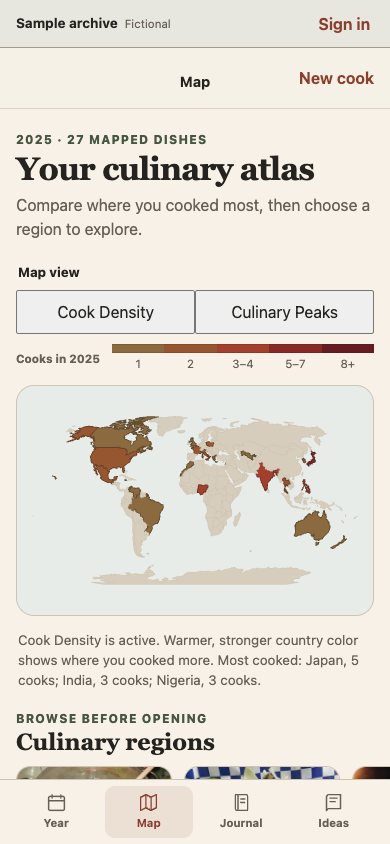
The same archive supports three perspectives: a chronological Journal, a photographic Year view, and a culinary Map. Dish histories connect repeat attempts; filters help rediscover a meal. Recipe Ideas can be imported or researched when requested, then saved as editable snapshots. Backup and restore give the owner a way to retain the archive outside the browser.
How it works
- Capture on the device
The PWA processes photographs locally and accepts a dish name, typed notes, or speech.
- Request help when useful
Authenticated cloud services transcribe speech or propose structured details from submitted text.
- Review and save locally
The cook confirms the entry; IndexedDB stores the occasion, dishes, attempts, and photographs.
- Rediscover the history
Journal, Year, and Map derive their views from the same account-scoped archive.
Cloud assistance is optional. The public sample reads a separate fictional dataset and does not open a private archive.
Cognito establishes who may enter the private app; it does not store the cooking archive. Network services receive the bounded inputs needed for a requested action. Personal photographs stay on the device. A separate metadata analytics path can record allowlisted activity without receiving meal records or images.
Stack and choices
- App and archiveJavaScript PWA · IndexedDB
- Keep capture, photo processing, and the source-of-truth archive on the device.
- Access and servicesCognito · API Gateway · Lambda
- Separate invitation-only membership from bounded cloud assistance.
- AssistanceAmazon Transcribe · Bedrock
- Turn speech into text and propose editable capture or recipe details.
- DeliveryAWS Amplify · Service worker
- Deliver the installable app and preserve useful local access when connectivity drops.
Decisions and design lessons
Capture effort is a product constraint. Photo and name form a minimal path. More capable assistance is useful only if it reduces effort without making the cook correct a long, unexpected form.
Suggestions should remain suggestions. The person can inspect and edit AI-proposed details. Deterministic local matching and country resolution handle tasks that do not need a model’s judgment.
Local ownership comes with responsibilities. Device-local storage protects the archive from routine cloud upload, but sign-in alone does not provide cross-device backup. Export and validated restore are part of the product, not an afterthought.
Current state and next step
The invitation-only PWA has a publicly accessible fictional sample. Repository records describe owner iPhone validation and client/service checks, with remaining device checks documented separately. A public sample demonstrates the experience without exposing a private cooking history.
A useful next question is whether repeat cooks can recover a specific past attempt quickly, especially as dish names and occasions accumulate. The public repository includes the product requirements, architecture, and media attribution.