Healthcare · Independent build
Patient Access Orchestration
An interactive model of patient-access work, exploring the decisions, exceptions, and human handoffs between a prescription and therapy initiation.
- My role
- Product strategy, workflow design & prototyping
- Designed for
- Patient-access operations and support teams
- Current status
- Public demo
- Define the policyPython rules & measurement
- Export the behaviorVersioned JSON manifests
- Explore the workflowReact · TypeScript · React Flow
A browser simulation. No runtime backend.
The product question
How can patient-access work keep moving when the next useful action depends on incomplete information? A prescription can pass through enrollment, coverage checks, prior authorization, affordability support, and pharmacy coordination. Each handoff can lose the reason a case is waiting.
Patient Access Orchestration makes those decisions visible through a synthetic demonstration. I framed the product strategy, designed the workflow and human-work model, and directed hands-on prototyping and evaluation. The intended users are the operations teams coordinating administrative access, rather than clinicians making treatment decisions.
The experience
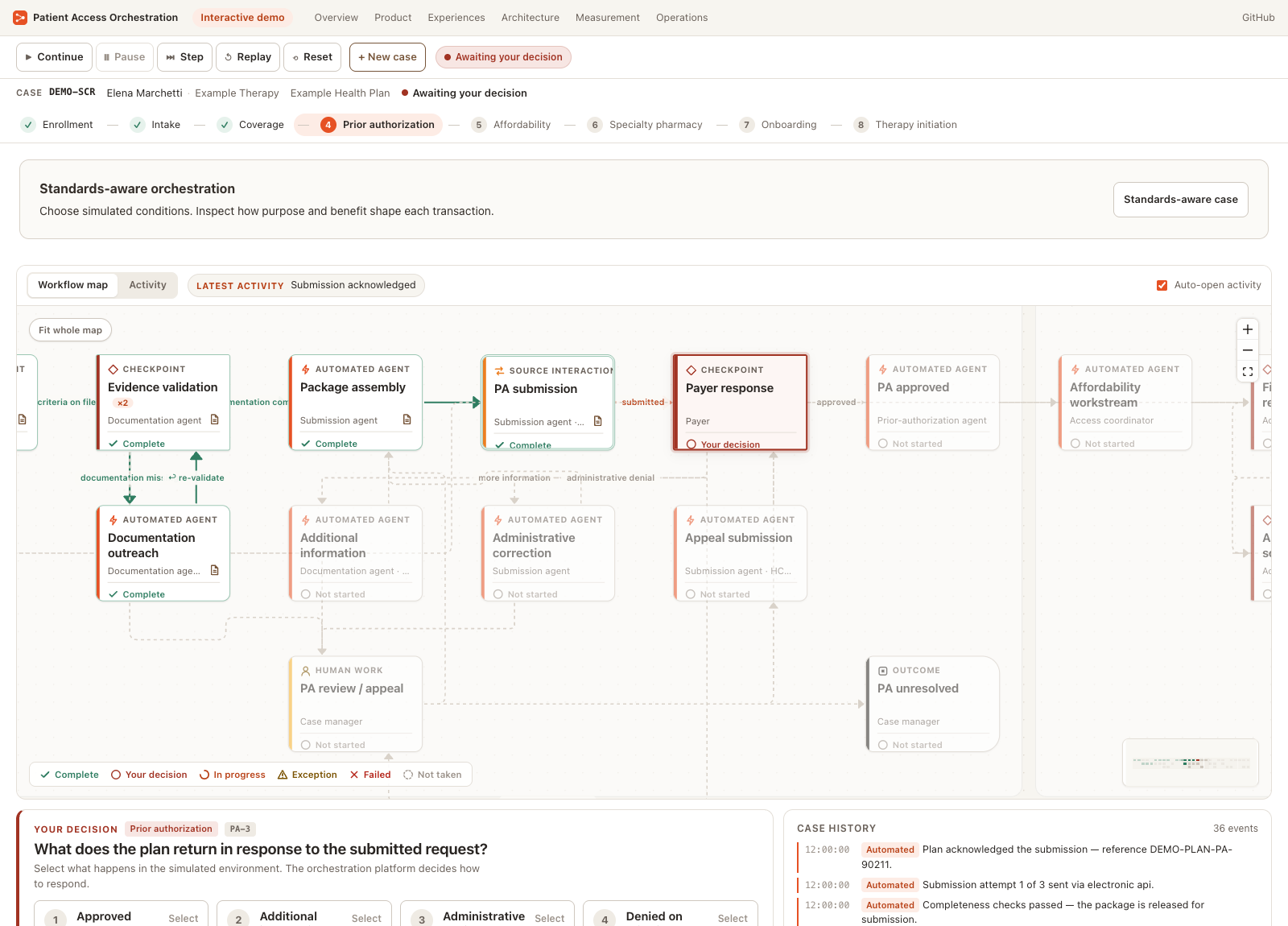
A case advances to a checkpoint. The viewer supplies a condition, such as a missing document, an unanswered inquiry, or a payer request. The platform then chooses a response. The workflow shows the selected channel, supporting evidence, recorded events, and the next uncertainty.
Operations brings exceptions into a human queue, where someone reviews sources and records an accountable resolution. Measurement compares strategies across the same synthetic cases. An experience gallery lets a visitor revisit recorded scenes without creating another transaction. Together, these views connect individual decisions to their operational consequences.
How it works
- Define and export
Python owns workflow rules, routing, human-work contracts, and the synthetic measurement model.
- Version the artifacts
Exported JSON carries simulation behavior and a separate measurement dataset.
- Explore in the browser
React interprets the manifest, draws the workflow, and records a temporary tab-local history.
The public demo has no runtime backend or healthcare integration. FastAPI and SQLite are a separate optional reference implementation.
The browser consumes the exported rules instead of maintaining a competing version of the policy. Analytics loads separately from the interactive workflow. That separation makes the hosted experience portable while keeping its simulated behavior traceable to the canonical definitions.
Stack and choices
- ExperienceReact · TypeScript · React Flow
- Connect the workflow canvas, checkpoints, and operations views.
- Rules and measurementPython · Versioned JSON
- Generate repeatable behavior and comparisons from one policy source.
- DeliveryVite · Static Sites hosting
- Serve a self-contained demonstration without a running reference server.
Decisions and design lessons
A delivered transaction is not a resolved case. Technical delivery, a payer determination, dispensing, and therapy initiation need separate evidence. Keeping these states distinct avoids a reassuring status that outruns what is actually known.
Stopping can be the correct behavior. Bounded retries, unresolved endings, and reviewed human handback make responsibility explicit. A workflow should preserve uncertainty when another automated attempt cannot resolve it.
Averages hide important tradeoffs. The synthetic comparisons show why fewer human touches are not automatically a better outcome. Earlier review can help complex cases even when progressive automation reduces work overall. Segment-level questions are more useful than declaring one strategy universally superior.
Current state and next step
The public demo includes workflow exploration, Operations, and Measurement. Documented rule, parity, and browser checks examine the simulation’s consistency; they do not establish real patient outcomes or standards certification. Voice, extraction, and AI-style recommendations are simulated.
A useful next experiment is to shorten the automated fallback budget for complex exceptions while holding the cases and evidence rules fixed. The full project experience provides the deeper product and measurement context.